Showing posts with label Chambers Street Wines. Show all posts

Saturday, October 6, 2012

Indigenous Yeast – Two Words that Speak Volumes


The wines that I love have one thing in common: fermentation is by indigenous or natural yeast.

A simple reference to indigenous yeast has cascading implications.  Least the way I see it after visiting many vignerons.  Indigenous yeasts can only be meaningful and successful if a vigneron practices viticulture in harmony with nature, hand-harvests, and minimal intervention in the cellar.  Pictured left is the Noella Morantin vineyard in Loire.

If a wine producer decides one day to use indigenous yeast after farming his vineyards conventionally with chemicals of herbicides and pesticides, it is not going to happen too easily over night.  Indigenous yeast lives in the vineyards.  So when vineyards are sprayed with chemical, there will not be enough indigenous yeast population for fermentation.

And if a wine producer uses a machine harvester, grapes burst and bleed before they make to cellar.  And as soon as the grapes bleed, it is grounds for a bacterial infection.  To stop the bacterial infection, a dose of sulphur must be added to the juice or crushed grapes.  Once the sulphur is added, the indigenous yeast is instantly killed.  So lab yeasts must be added.  And to feed the lab yeasts, additional chemicals need to be added.  And so a list of intervention continues.  Over-worked or intervened wines to me taste flat and soupy.

To me, the difference between the wines made from indigenous and lab yeasts are significant. The ingenious yeasted wines are lively and fresh.

The story behind indigenous yeast came up when I was listening to I’ll Drink To That – an excellent podcast out of New York where ex-sommelier Levi Dalton interviewed David Lillie of Chambers StreetWines.  I strongly recommend the podcast.  It is genuine, entertaining and educational.

I never bought into the idea that just because one can sell the wines, one doesn’t have to ask how the wines are made and taste.  I always thought it is the other way around: Because one knows how the wines are made and taste, one wants to sell them. 

Monday, February 27, 2012

Les Caves Auge in Paris

In Paris, an unassuming wine shop in the 8th Arr. has influence on wine lovers like no other.  The wine shop, like the majority of the vignerons that Auge represents, is simple and humbling that if you are not familiar with Auge, you may skip it without giving it too much thought. The website says in a small font ‘depuis’ (since) 1850 and not much else.

It is a wine shop that is absolutely clear on what it represents.  In terms of philosophy, Auge reminds me of another great wine shop - Chambers Street Wines.  Both wine shops are hugely successful.  


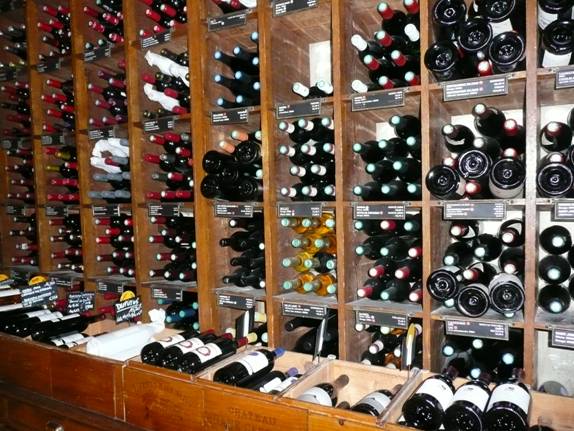
There is greatness and joy about a wine shop that is steered by the focused ideal of owners and not by the broad sense of general consumer.  Least to me, Auge has no interest in pleasing everyone.  If you love wines made by vignerons who give a shit, you will likely love Auge.  Auge is so jam packed with wines that, if it were in BC, a city would close it down by quoting some silly bylaw.  The photo is the inside Auge taken during my last trip.

I can spend hours in Auge.  If you are in Paris, it is a great place to spend some time.  And, say, you are looking for a special wine like Pierre Overnoy from Jura, ask sales staff. He or she may disappear down to a cellar and fetch a bottle for you - provided that you pass the unofficial sales staff's verbal wine test.  Or simply grab a bottle or two that you never heard of, buy a baguette sandwich, and dance down to the banks of Seine with a corkscrew and glasses.  And oh, you can have wine with a baguette sandwich in public places in Paris and not worry about a social disobedience ticket.  If weather is unfriendly, I usually go back to my hotel room – which is just as nice.  

Wednesday, December 8, 2010

A Short Version of How I Became a Wine Importer

I remember trying a red wine for the first time. I was in my early twenties. I remember holding my breath just to get the forsaken liquid down by throat so as to be polite in front of family and guests at the dinner table. You see, I grew up in a family where wine was not a part of the meal. Being an immigrant Korean, the daily dinner table was full of condiments consisting of burning hot peppers, pungent vinegars and sesame seed oil.  All very tasty but not exactly the ingredients that beckon one to declare: “Well, with those dishes, I should go down to the cellar and retrieve a bottle of Les Amoureuse or Morgon”.  

Fast forward ten years. Cooking always has been my hobby. When I started delving into cooking the classic French dishes, the topic of wines kept coming up. It didn't take long before I was immersed in wine.  I even took a part time consulting assignment for a local wine agency. It was inevitable that the course of my life would see me choose something related to wine

Deciding to become a wine importer was easy.  I struggled for a long time with the thought of what would a wine importer represent or what does a portfolio of wines say about an importer.  I only knew what I did not want as a wine importer. The thought of chasing after hot wines of the moment never appealed to me because I personally don’t drink them and I never saw wine as fashion.   The thought of chasing after highly rated wines never appealed to me either.  It used to.  But I noticed the high scored wines simply sat in the neglected corner of my cellar.  I did not want those wines anymore.  They tended to be oaky fruit bombs. I didn’t like putting bombs in my mouth. Asking someone else to drink something I wouldn't does not sit well with me.


A Rabbit Terrine, Salad &  Charcuterie at Racines in Paris in 2007 with Artisanal Beaujolais

Then, a lightning struck across my consciousness when my wife and I took a vacation in Paris in 2007.  We somehow ended up in a series of bistros that were serving most delicious food and wine from the producers and regions that I never heard of - Ploussard, Pineau d’Anis, Trousseau, Savoie, Bugey, and Pupillon. The list went on. I must have looked like a child seeing a candy jar in a corner store for the first time because the owner Pierre Jancou at Racines, a wine bistro, poured me samples of wines to taste.  I never have forgotten that moment and the generosity of Pierre.  The name Racine Wine Imports is in honour of that man. Racine means ‘root’ or ‘to take root’ in French. 

I thought such wines must only exist in Paris. Taking a trip to New York and San Francisco was an eye-opener.  Similar wines were available there, too.  If you ever visited accessible, friendly places like Nopa or Terroirs in San Francisco or Chambers Street Wines, Balthazar or the Ten Bells in New York, you know what I mean. 

With the trips in Paris, San Francisco and New York, I was beginning to know what I wanted as a wine importer.  I wanted to represent the winegrowers who work the land responsibly, making honest wines - the wines that are pure, balanced and delicious.  The winegrowers that I believe in and can stand behind. These are the wines that my wife and I would like to drink with friends and families at a dinner table with foods.