Sunday, May 29, 2011

An Artisan in Our Own Backyard – Mix the Bakery

Every time I drop by Mix the Bakery, I feel like we have a treasure in our own city.  Although I live across the city, I make a point of dropping by the Mix. Of all the great bakeries in Vancouver, the baguette from the Mix reminds me of the ones from France the most.  The baguette is crusty on the outside and moist & airy inside.  A tub of butter, a loaf of the Mix baguette, plus a glass or two of good wine equal BLISS.   

For all the years that I have been going to the Mix, I never met the baker.  So, I decided to meet the baker during my last visit and asked the staff.  “Rose is the co-owner and baker.  She is at the back”, the staff said as she gestured to the back.  I walked past the ladies of bakers at the back, the trays of resting dough, and the stacks of flour sacks.  I had to pause to take in the fragrance of baking permeating through the air.  The ladies said, “Keep walking.  More.  More.  Rose is in her office. Yes, to the left”.  I walked-in unexpectedly and met my local artisan baker hero.  The beauty of the baguette matches the beauty of the boulangère.

The Mix, in addition to the crusty Parisian baguettes, has a variety of breads, desserts, preserves, sandwiches and soups.  By the way, their preserves are essence of fruits.  And their coffees, made from the La Marzocco machine, are always perfect to my taste.  It is as though every single thing in the shop has been touched by the care and dedication of Rose and her staff.  The next time you want to catch an artisanal moment in our own city, I suggest the Mix.

As I walked out of the Mix, the spring passing rain had turned into a sunny afternoon.  And it is a Friday!  With a loaf of Rose’s bread in my arms, I reached to look at the business card that she had given me.  Her title says, ‘DOUGH GIRL’.


Saturday, May 21, 2011

Odd & Perfect Couple – Chinon and Salmon

Here is a food and wine combination that I don’t think about too often: Chinon and Salmon.  At first, the combo sounds odd – like a peanut butter & jelly sandwich, sweet & sour soup, or Korean & Mexican taco. Our beautiful local salmons are now in season, starting with the Spring Salmon.


Chinon is an appellation in Loire, about 300 km southwest of Paris.  Chinon is a Cabernet Franc country.   Cabernet Franc is better known as Breton by the locals.  The locals sometime simply call the varietal Cabernet – meaning not Cabernet Sauvignon.  Chinon wears many expressions, all to do with where it is grown, vintage and, of course, the vigneron.  Gererally speaking, Chinon grown on sandy soils gives beautiful, perfumed wines that are meant to be enjoyed in its youth.  Bernard Baudry ‘Les Granges’ (pictured) is such an example. The same Chinon grown in a gravel and/or clay over limestone, will likely give structured wines that will benefit from some cellaring. 

Matthieu Baudry and his father Monsieur Bernard Baudry are seeking finesse and elegance in their wines.  Les Granges is usually no more than 12 to 12.5% alcohol.  The vines are grown in harmony with nature.  The grapes are harvested by hand – a rarity in the region nowadays.  The wine is fermented only using indigenous yeasts in concrete vats and bottled unfiltered in the late spring or early summer the following year.  The 2009 vintage is long sold out.  Matthieu informs me the 2010 Les Granges will be bottled this June.  The wine will be shipped this autumn and will arrive on our shores in October/November. 

The Les Granges 2008, the one I am enjoying now clocks in at 12% alcohol.   You can share a bottle over a dinner and don’t feel the vertigo.  The combination of Chinon Les Granges and our local grilled salmon is CONSCIOUS BLISS.

Friday, April 1, 2011

The Foillard Connection

When I was visiting the vignerons last autumn, happy coincidences kept happening.  I was beginning to believe the universe was conspiring in my favour.  It all started when I was visiting Jean Foillard in Morgon.  As I was visiting a number of vignerons in the region, I decided to stay at the bed and breakfast of Jean Foillard for a couple of days.  By the way, if you love France and wine, not to mention the beautiful villages, I strongly recommend Jean Foillard’s B&B.

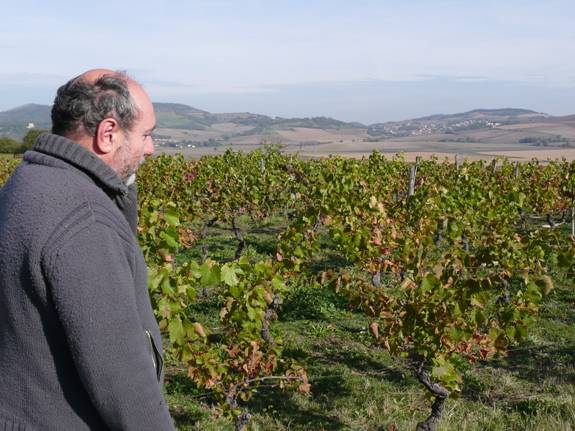
 An Autumn Scene Steps from Jean Foillard's Domain

Back to the story…Well, Monsieur Foillard asked if I wanted to join the family for a lunch.  Oui!  In the middle of having a delicious lunch that Madame Foillard prepared for us, Monsieur Foillard stood-up, disappeared and returned with a bottle of white wine, declaring that the meal begs for a glass of white.  There was already a bottle of Côte du Py on the table.  I barely kissed my lips on the Côte du Py that Monsieur Foillard poured for me to taste enjoy.  The bottle of white was no other than Thierry and Jean-Marie Puzelat Le Clos du Tue-Boeuf Pinot Gris.  Crisp, minerally and delicious.  There were now two glasses of generous pours in front of meal.   BLISS CONSCIOUSNESS!  I chuckled and informed Monsieur Foillard that I will be visiting Thierry and Jean-Marie Puzelat of Le Clos du Tue-Boeuf in a few days.  A pause, then Monsieur Foillard glanced at me in a different light.  I am not certain but I think that was the moment when Monsieur Foillard decided to give me some allocation to import. 

 The Entrance to Jean Foillard's Tasting Room. Also Used For Harvesters to Enjoy Meals

Then, I was visiting Thierry and Jean-Marie Puzelat at their Le Clos du Tue Boeuf.  During a tasting, a sample of Pinot Gris was poured.  The very cuvée that Jean Foillard had poured for me at his domain only a couple of days ago.   I chuckled and told Thierry about the Pinot Gris at Jean Foillard.  A pause, then Thierry glanced at me in a different light.  I am not certain but I think that was the moment when Thierry decided to give me some allocation to import.

With Thierry Puzelat at Le Clos du Tue-Boeuf Amongst the Vines, Surrounded by Diversity of Forests 

Then, I was visiting Jean Maupertuis.  After a tasting, I followed him to his personal cellar for a tour.  What a cellar! Well, what do I see among the wines?  Jean Foillard’s ‘PI-π’ – a wine only made in certain vintages.  I chuckled and told Jean Maupertuis that I just visited Jean Foillard the day before.  A pause, then Jean Maupertuis glanced at me in a different light.  I am not certain but I think that was the moment when Jean Maupertuis decided to give me some allocation to import.

Jean Maupertuis among the Vines at Le Guillaume Vineyard (500 m above sea level on limestone)

Then to top it off, I was visiting Noëlla Morantin.  When I arrived at her domain, she had nothing to sell.  All her bottled wines were sold out.  Generously, she had to dip into her personal stash to give me a taste.  A conversation led to many things and Noëlla asked what other vignerons I was visiting.  I told her all the names.  Apparently, Noëlla just returned from Jean Foillard.  I am not certain but I think…

 Noëlla Morantin Pouring Generously in her Beautiful Chai/Cellar

Saturday, March 5, 2011

Monk Fish with Preserved Meyer Lemon

My preserved meyer lemon, from the previous post, was made a month ago and is ready to be enjoyed.  With the preserved lemon, I made a monk fish dish.  Monk fish is from the icy waters of Atlantic.  I see the fish every now and then at this great fish monger.


First, I made a mixture consisting of ¼ piece of preserved lemon diced, pinch of shallots, julienned parsley and some olive oil.  The preserved lemon should be salty enough to skip adding more seasoning.  Set aside.  Warm the plates in an oven heated to 150 F.

I cut the fish biased about ¼ thick, placed a couple flat-leaf parsley leaves, and some pepper.  I wrapped the fish with a prosciutto.  The prosciutto was salty enough.  So I skipped seasoning.  Heat the pan hot enough that it is smoking when a few tablespoons of olive oil are added.  Dust the fish with flour.  Two-three minutes of cooking on each side of fish.  Tilt the pan and glaze the fish with hot oil using a spoon.  Plate the fish with some of the preserved lemon mixture.  The family had the dish with a light-bodied red Burgundy from the 2004 vintage.  It was yummy.

Sunday, February 27, 2011

Meyer Lemon – the Grand Cru of Lemons

There are lemons and there are meyer lemons.  They are in season in January and February.  To me, meyer lemons are a class by themselves – hauntingly aromatic, sour and yet slightly sweet.  I simply slice them thinly right into salads, with skin and all.  I would like to add meyer lemon rinds into our local tuna tartar dish with say sauce, green onion and a dash of sesame seed oil.  I like the tuna tartar with toasty baguette slices or make it into a cone with nori and rice.  A crisp, minerally Champagne or Vouvray Sparkling or Montagnieu Sparkling (from Bugey near Savoie) would accompany the dish well.

Sometimes, I like to simply finely chop meyer lemon with parsley and shallots.  Add some salt and good quality olive oil.  A few raisons can be added to balance the salt and sour.  Spoon the mixture over grilled or pan fried fish or roasted chicken.

To extend the pleasures of short-lived season of meyer lemons, I like to preserve them.  Simply cut them into halves or quarters, sprinkle about 1 table spoon of kosher salt per lemon, pack them into sterilized jars, and squeeze a few more meyer lemons to top it off. I like to keep the preserved lemons in the refrigerator rather than out in the room temperature.  I think the cool preservation keeps them aromatic and crunchy.  The preserved lemons should be ready to enjoy in about 1 month.

The preserved meyer lemons are, of course, classic in Moroccan cooking.  One of the best books is by Kitty Morse – ‘Cooking at the Kasbah’.  Moroccan dishes are very wine friendly, least to my palette. 

Meyer lemons are available at specialty shops, including this one.

Saturday, February 5, 2011

Georges Descombes - Vigneron's Care and Committment

Recently, I came across this video by Aurélia from Quebec.  I don’t believe you need to speak a word of French to understand in this case.


After receiving the reservation confirmation from Georges Descombes for his 7 cuvees (the crus of Brouilly, Chiroubles, Morgon and Régnié, plus the Vieillles Vignes cuvees), I could not sleep a wink.  I am so HAPPPPY!  The wines will be on our shores this spring in April/May. 

I distinctively remember my visit to Georges Descombes.  As I entered his dark-lit, icy cellar and sat down, he poured me a glass from the half-full bottle.  In unison, Mrs. Descombes and Georges genuinely offered: “It was opened yesterday. Please let me know if you would like me to open a new bottle”.  It was Brouilly Vieilles Vignes 2007.  I drew the glass towards me to taste.  Then, silence.  In that instant, something connected.  A mystically mysterious moment that is ephemeral and yet eternal.  It was as though this vigneron’s care and commitment, disguised as wine, were in that glass.  There was no need to open a new bottle.

Friday, January 14, 2011

An Artisanal Oyster Shucking Knife

No self-respecting wine importer, who has two artisanal Muscadet producers on the portfolio, should be without a decent oyster knife.  Oysters, especially raw, are a magnetic match with Muscadet.  Having a pitchet of Joseph Landron Muscadet at Les Pipos in Paris in October 2010 was one of those food conscious bliss moments.  A similar experience happened at Balthazar in November 2008 with a plate of oysters and a bottle of Marc Ollivier’s Domaine de la Pepiere Muscadet.  Now, I can have the consciousness bliss experiences at home very soon when the Muscadets arrive in April or May of this year.  I truly believe our BC coasts have world-class oysters.

I have had my share of cuts and bruises from shucking oysters.  Having a bad oyster knife did not help.  My wife and I were strolling through this fine kitchen ware shop and I accidentally came across this oyster knife.   It is about $20.  


I recycled the tag that came with it.  So, I can’t recall the details but if my memory serves me correctly, the oyster knife has been around since the 1920’s.  Painfully recalling the cuts and bruises of the past, and wearing a rather fresh cut from shucking the oysters a couple of days ago, I purchased the oyster knife.  I figured a tool that has been around that long must have its reasons.  The oyster knife feels and looks as though someone put a lot of care and thought into making it.  I get the feeling that it is made by a proud person in the same Massachusetts shop that has been around for awhile.

Well, the oyster knife is simply the best.  It comes in neutral wood and carbon-steel.  It has just enough give (i.e. flexible).  With the carbon blade, you need to wipe it dry after use to keep from rusting.  It is well worth the chore of wiping.  Now I can enjoy a plate of oysters with a glass or two of Muscadet without wearing a band-aid.  A bonus!