Showing posts with label Thierry Puzelat. Show all posts

Wednesday, September 17, 2014

Concrete Vats – Pure Perfection


see concrete vats in the cellars of the vignerons whom I respect and whose wines I love. Matthieu and his father Bernard Baudry have concrete vats in their chai; Thierry Puzelat and his brother Jean-Marie have them; and Jean Maupertuis has them, too. There is something supremely pure about fermenting and aging wine in concrete vats. They are neutral. They do not take away or add anything. The thermal inertia of concrete vats is enormous. Thus, allowing the wines at a steady temperature. Concrete vats breath. The wines that see concrete vats are not as 'square' as, say. from those wines that see stainless steel vats.

There is wonderment of energy and purity about the wines that see concrete vats. I especially like wines that spend their time in the traditional concrete vats. Jean Maupertuis, for example, has concrete vats that are probably made before WWII. Jean Maupertuis himself does not know when his concrete vats were made.  The picture above is Jean Maupertuis in front of his concrete vat. Oh heck, Jean Maupertuis' vats are not even ergonomic. When I visited him in the tiny village of Saint-Georges-sur-Allier in Auvergne, he chuckled as he was explaining the concrete vats in his cellar.  The draining sprouts are located about a couple feet above the bottom of the vats rather than at the bottom.  So, he has to take a bucket and scoop out the remaining juice after fermentation.  Despite the extra labour and hassle, Jean Maupertuis keeps the concrete vats for a reason.  I can taste the freshness and purity that is rare in wines.

Saturday, October 5, 2013

Cheese Plate – A French Experience

Cheese plates in France are, well, just awesome.  I remember eating at Chez Michel in the 10th Arrondissement in Paris a few years back.  The table next to us ordered a cheese plate, which always follow after the main entrée.  A dizzying array of cheeses arrived in a huge wooden cutting board.  A proper cheese plate always has a brick of butter and is always accompanied by a basket of crusty bread.  I wanted to order the cheese plate but I was just so full. At Chez Michel, like many fining restaurants throughout France, the cheeses arrive in tranche, round, or brick.  The idea is to help yourself to cheeses.  It is simply spellbinding to see the French devour cheeses after main entrée with aplomb.  It is rumoured the French have a separate stomach for this separate dish.  Now, when I am in France, I enjoy a cheese plate as a part of dinner.  And I always lose weight when I am in France.  It is a mystery.

Pictured above is the cheese plate at Jean Foillard in Morgon during my last visit to the domain.  Jean and Agnès Foillard make the cheese plate look so effortless.  Jean and Agnès also serve butter with their cheese plate – of course.  White wines are generally better accompaniments to cheeses.  I personally like Loire or Jura white wines with a cheese plate.  I noticed Jean and Agnès Foillard served the whites from Thierry Puzelat of Clos du Tue-Boeuf in Loire with their cheese plate.

By the way, LesAmis du Fromage has awesome cheese selections.  And Les Amis is where I shop every time I have a French craving for a cheese plate.

Wednesday, April 24, 2013

Liveliness of Pétillant


I only encountered the liveliness of pétillant in wines when I started drinking the wines that are traditionally made.  It is even easier to appreciate when a vigneron, like Thierry Puzelat, guided me through a tasting.

Pétillant literally means sparkling.  In the context of still wines though, it means a little tingling sensation in wines from naturally occurring carbon dioxide, which is a by-product of fermentation.  Traditionally, the pétillant is kept (i.e. wines are not de-gassed completely) intentionally because carbon dioxide is a natural preserver.  If wines are completely de-gassed, which is the case for about 99.9% plus of wines nowadays, additional sulfur would have to be used.

For the uninitiated, the pétillant taste can lead to falsely believing the wine is still fermenting.  For the traditionally made wines, pétillant gives that lovely liveliness. If you do not like pétillant, decant the wine for about ½ hour and all that beautiful pétillant taste will be gone.

The pétillant is only apparent in young bottled wines.  After a year or so in bottle, the pétillant fades.  For me, the pétillant stage of young wine is ephemeral and attractive.  When Le Clos du Tue-Boeuf ‘La Butte’ Gamay 2010 arrived on our shores, the wine had that striking pétillant.  After a few months, the wine has lost much of pétillant but has kept that stunning fragrance and freshness.

You can listen directly from the respected Burgundy vigneron Jean-Marie Fourrier in this podcast about pétillant.  Jean-Marie rhetorically asks: “Why replace the gift of natural preserver of carbon dioxide with chemical sulfur?”  If you are lucky enough to come across a bottle of Jean-Marie Fourrier wines, I urge to buy it.

I am at a point now where when I try young wine and taste zero pétillant, I ask why the vigneron chose to de-gas the natural preserver gift of carbon dioxide and replace it with abrasive sulfur. 

Saturday, December 29, 2012

Gamay – Celebrations at Dinner Tables


Recently, I had the pleasure to meet a sommelier from Quebec.  She was staying for a few months in our town.  She has worked a few harvests in France with the vignerons whom I respect.  While enjoying a few bottles of wines with her and other friends over a dinner, she blurted out: “Gamay is my favourite.  It accompanies foods so well.”  She went on to say: “Gamay creates an ambiance at a dinner table that no other wines can.” Those are meaningful words that are difficult to describe in words.

With her declaration, I noticed that every bottle on the dinner table was Gamay or a Gamay blend: Noella Morantin ‘Mon Cher’, Puzelat-Bonhomme ‘Le Tel Quel’, Clos duTue-Boeuf ‘La Butte’, Christophe Pacalet ‘Fleurie’, Jean Maupertuis ‘Les PierreNoires’, and Jean Foillard ‘Morgon Cuvee Corcelette’.   Unconsciously, I had brought-up all Gamay and Gamay blends from the cellar for the dinner.

My love for Gamay and Gamay blends know no bounds. Gamay grown in the volcanic hills of Beaujolais and its 10 crus are generally fuller than the Gamay grown on the limestone hills of Loire. Gamay, made with care, has butt-naked exuberance and deliciousness that no other wines can match.  And the prices are so reasonable.

Perhaps, it is the butt-naked exuberance that is translated to the ambiance at dinner tables.  Such ambiance is palpable at my favourite neighbourhood restaurants in Paris: La Nouvelle de Marie, Le Comptoir, Bistro Paul Bert, Le Bratin and Les Pipos.  All restaurants have numerous Gamay and Gamay blends.  Once you experienced such an exuberance evening at one of the restaurants, that joie de vivre will stay with you a lifetime.  Our great local restaurants (L'Abattoir, Pied-A-Terre, Tableau Bar Bistro, La Regalade, Wildebeest and The Acorn - just to name a fewnow also carry Gamay and/or Gamay blends from great producers.  

There are more profound wines from other appellations in France, but I cannot think of another varietal that speaks so joyously at a dinner table than Gamay.  Every time my family has a bottle of Beaujolais, Auvergne or Loire Gamay over a meal, I swear there is a hole in my wine glass.  It is empty every time I look at it.

Thursday, June 14, 2012

A Canadian Mosaic Dinner - A Korean Dish That Actually Works with Wine!


I was born and raised in Korea.  So, I can declare that this dish actually works with a wine.  As much as I like Korean foods, they are full of peppers, vinegar and pickled-flavours.  Kimchi with Bordeaux or Riesling? I don’t think so. The flavours often fight with wines.  So, it is rare to find a Korean dish that tangos with a wine.  Here is my recipe (serves about 4 people).

  • About 1 pound of flank steak
  • 2 cloves of garlic
  • ½ cup of dices onion
  • 1 green onion
  • 3 table spoon of quality soy sauce
  • 1 teaspoon of sesame seed oil
  • 3 to 4 table spoon of brown sugar
  • Dash of black pepper
  • 1 or 2 pinch of course grey salt
  • 1 cayenne pepper (optional)

First, pour yourself a glass of wine. Cut the flank steak into about 3 by 6 inch sizes.  Set the meat in a non-metal container large enough to hold the meet in one to two layers.  Place the rest of ingredients in a mortar or an electric mixer or blender.   Blend for a few seconds until the mixture is roughly smooth.  Pour the mixture into a bowl. Dip your finger into a mixture (in the bowl and not in the blender/mixer - for safety) and taste.  It should be somewhat salty, sweet and hot with a whiff of sesame seed oil fragrance. Adjust salt & sugar, if necessary.

Mix the marinade well with the meat.  Marinate the meat for 2 to 3 days in a refrigerator. Turn over the meat a couple of times.  The flank steak needs long marinating because it helps to tenderize the toughness of the cut – although it is one of the most flavourful cuts.  Fire-up your BBQ. Meanwhile, place a plate in the oven at 150F to warm and to rest the meat after it has been cooked. BBQ the meat to no more than medium rare.  Place the cooked meat on the plate and into the oven.  Turn the oven off and let the meat rest for about 20 minutes.  Slice against the grain about ¼ inch.  

Good with plain short grain or jasmine rice. Even delicious with baguette or roasted potatoes.  Serve with a salad.  Or how about a pasta dish and some stirred-fried vegetables with the meat.  I am in Canada after all, blessed with riches of ethnic foods – no need to stick to a formula, hey. 

The dish goes well with Cuvee Granit from Domaine de la Pepiere of Marc Ollivier or Crus (Descombes, Foillard or Pacalet). The spicy, sour-cherry Le Telquel from Puzelat-Bonhomme is a fine accompaniment.

The leftover meat makes a wicked sandwich.  Just splash some mayo, hot mustard and instantly-pickled onions (sliced onion with some salt, sugar and vinegar – mix & soak for about 1 hour or overnight).
     

Tuesday, May 15, 2012

Thierry Puzelat & Pierre-Olivier Bonhomme – ‘Le Tel Quel’


With a label that depicts a dachehund with tail wagging and name that no English speaking person can pronounce, this wine has all sorts of names. Here are some of the names when the customers phone or email me after tasting the wine:


  • “You know, the wine with a wiener dog”
  • “The one with a funny label”
  • “The T-Q” (my favourite so far. Sounds like a spy character.)
  • “The one with no vintage”
  • “The one with Blue Label”
  • “The one with all the varietals except the kitchen sink”
  • “The delicious, spicy wine that is made by that Puzelat guy”
  • “Never mind, I am sending you the picture of bottle on my iPhone right now”
All those nicknames are welcome, of course.  And I think that is what Thierry Puzelat had in mind when he came-up with the wine.  In France, it is bottled under the name of ‘Le Pitit Tannique’.  Every year, Thierry Puzelat takes a barrel or two to the legendary wine shop Auge in Paris and bottles by hand for the customers, who line-up to buy them.

Thierry Puzelat is a gifted and serious vigneron, but he is always on the look out for fun.  Thierry Puzelat with his wine business partner Pierre-Olivier Bonhomme (hence the name of their winery ‘Puzelat-Bonhomme’) decided to have fun by sourcing organically grown grapes from the friends that Thierry and Pierre-Olivier have known for years.  By the way, Pierre-Olivier Bonhomme is just as gifted vigneron, who has been working in the Puzelat family’s domain LeClos du Tue-Boeuf for years.  The wine is a blend of (are you sitting down?) Grolleau, Gamay and Pineau d’Aunis.

‘Le Tel Quel’ is Vin de France because those funny Appellation d’Origine Contrôlée in Loire (whose members mostly consist of huge industrial wine producers) thinks that the traditionally grown Grolleau and Pineau d’Aunis should not be allowed in the AOC Touraine.   Until the 2010 vintage, under the Vin de France, the vintage was not allowed on the label.  I am not certain that Thierry Puzelat and Pierre-Olivier Bonhomme would ever label it with the vintage.  The latest shipment is the 2010 vintage.  The wine is produced in tiny amounts and it sells out every year based on the strength of the vigneron.  Be very picky about your vigneron, not the vintages.

All fun aside, the wine is one of the most compelling and DELICIOUS wines.  The wine even tastes better chilled.  Thierry and Pierre-Olivier serve the wine straight from the cellar temperature when I visit them.  The wine has that spicy taste with berry exuberance anchored by a touch of minerals.  With alcohol barely hitting 12.5%, the wine is very fresh. At our home, we have it with a wide range of dishes, such as roasted chicken, steaks, pasta, and even grilled salmon.  In an unexpected sort of way, Thierry Puzelat’s ‘Le Tel Quel’ has become our house wine.  And I am beginning to understand why those Parisians line-up to buy the wine at the wine shop Auge.


Saturday, April 21, 2012

A Match Made in Heaven – Our Local Salmon & Loire Reds


Every year, I look forward to spring for many reasons.  One of which is our local spring salmon.  This is one of my favourite ways to cook spring salmon (serves two):

-          2 fillets of spring salmon with skin and ping bones removed.
-          1 TBS of grainy mustard
-          1 TBS of honey
-          1 TBS of finely diced shallots or green onion
-          1 TBS of chopped Italian parsley.
-          2 TBS of fresh squeezed lemon (about ½ of lemon)
-          Salt & pepper to taste.
-          5-6 TBS of olive oil.


Heat oven to 450 F.  You will need a 8 to10 inch pan that can go from the stove to oven (i.e. a pan with a metal handle). 

Mix the mustard, honey, shallots/green onion, parsley, and lemon and stir to make a sauce.  Add salt and pepper to taste.  Set aside.  Use quality salt.  I buy grey sea salt, dry it out on a tray, and crush the salt in a mortar.

Salt and pepper the fillets both sides.  Heat the skillet pan to almost high.  Add the oil.  The oil should be smoking in the pan.  Tilting the pan to slide the oil to the bottom of pan and away from you.  Add the pieces of salmon, fillet side down (i.e. boned side down for presentation purposes only).  Cook for about 2 minutes until the fillets have a good brown crust.   Flip the fillets and cook for about a minute.  Spoon the sauce over the top of the salmon.  The dripping sauce over the fillets and onto the pan will spatter.  Transfer the pan into the preheated oven. Cook for about 2-3 minutes.


Buttered jasmine rice, spring potatoes or rice pilaf is a great side dish.

All light reds from cooler climate work well.  Beaujolais from a balanced year, such as 2008 and 2010 works well.  Auvergne Gamay grown on mountains, such as 'La Guillaume' or 'Les Pierre Noires' from Jean Maupertuis are also a superb match with the salmon.  Cheverny Rouge, which is a mixture of Pinot Noir and Gamay (iBurgundy, the equal version is ‘Passetoutgrain’) is ravishing. 

For me though, pure Gamay from Loire is a match made in heaven with our salmon dishes.  La Butte (100% Gamay) from Le Clos du Tue-Boeuf from the family domain of Thierry andJean-Marie Puzelat is awesome with the salmon dish.  La Butte, like all Thierry and Jean-Marie Puzelat’s wines, has intentional residual carbon dioxide – which occurs naturally during wine making process.  The carbon dioxide keeps the wine ALIVE and vibrant.  You can decant it, if you prefer, and the ‘pearly’ taste of carbon dioxide will be gone in about 10 minutes.  Thierry Puzelat serves his reds straight from the bottle with the ‘pearly’ feel intact and straight from his cellar at 10-12 C deg.  If you don’t have a cellar, placing the bottle in the fridge for about 30- 40 minutes or 10 minutes in a Champagne bucket with ice & water will do.  The cool temperature really brings out the freshness and perfume of the light reds.

Thursday, March 15, 2012

Doubt the Conventional. Taste the Exceptional.

I recently read an article about Lauren Hutton. Unbelievably, she was told to fix her gapped-teeth if she wanted a career in modelling.  I just read in New York Times T-Magazine about Lana Del Rey. Some criticize her looks because her lips are too voluptuous.  The recent T-Magazine also mentioned about Willem Dafoe, who was also seen in not-so-positive light about his rough face. Well, to me, Lauren’s teeth, Lana’s lips and Willem’s face are beauty in truth.  Doubt the conventional. Experience the exceptional.

I used to love Sauvignon Blanc from all places.  Then about ten years ago, I stopped drinking the varietal.  They started to taste just about the same. “This bottle is text-book Sauvignon Blanc” is the phrase I often heard.  When someone tells me a wine is textbook varietal, the wine should remain in textbooks.

Where is my Lauren’s gap-teeth in this bottle of Sauvignon Blanc? And who surgically thinned my Lana’s lips in my Sauvignon? And who smoothed out Willem’s rough face in this bottle of Sauvignon? Damn it!

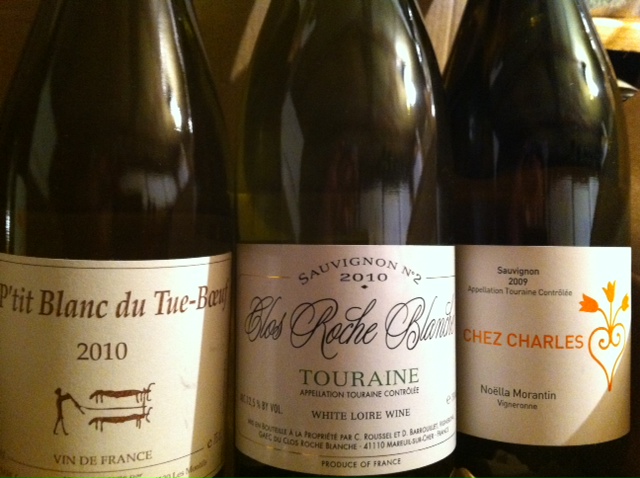
I rediscovered the beauty in truth in Sauvignon Blanc (the French simply call it Sauvignon) when I visited, tasted and learned from Clos Roche Blanche, Noëlla Morantin, and Thierry Puzelat.

Sauvignons from Thierry Puzelat (Le Clos du Tue Boeuf), Clos Roche Blanche and Noëlla Morantin


“The wine is in true expression now than when it was first released”, spoke softly Didier of Clos Roche Blanche.  He was referring to the 2010 Sauvignon No. 2 as we tasted the various wines in the cellar during my January 2012 trip. Clos Roche Blanche Sauvignon No. 2 is so singular. When tasted out of a barrel, the Sauvignon No. 2 is so energetic that I fear the wine is going to shatter the glass that I am holding.  The wine is like sucking mineral through a straw with a fruit that reminds of grapefruit. After about a year in bottle, the wine transforms not dissimilar to Chenin Blanc but not quite.  The fruit recalls quince.  The minerality remains. 

When I visited Noëlla Morantin, a marquee Sauvignon vigneronne, she had two different Sauvignons in the barrels/demi-muids.  Hers are released later when the youth of Sauvignons settles down to quince and minerality reflections.  Her Sauvignon ages gracefully.  Thierry Puzelat also makes Sauvignon wines and his is often blended with a portion of Menu Pineau and Fie Gris.  His Sauvignon based wines are full of energy and nervous tension. “Le P’Tit Blanc tastes better the next day after the bottle has been opened”, a local merchant told me recently.  And that sums up the freshness and energy in the Thierry Puzelat’s Sauvignon.

The majority of Sauvignon Blanc on the market today does not go through malolactic fermentation.  Since the majority of vineyards are industrially farmed and mechanically harvested (about 95% according to Art of Eating, September 2010 issue).  This mechanical harvest results in grapes to bleed before they arrive at the winery.  So, to prevent the bacterial spoilage, the juice is dosed with sulphur.  It kills the bacteria, which is required for the malolactic fermentation.  Thus by a default, the malolactic is prevented.  There are, of course, vignerons who cultivate organically and harvest by hand but intentionally block malolactic fermentation to achieve a certain style. 

Clos Roche Blanche, Noëlla Morantin and Thierry Puzelat all let their Sauvignon go through malolactic fermentation. “By nature, the Sauvignon wants to go through malo”, was a recurring theme when I visited them.  Clos Roche Blanche, Noëlla Morantin and Thierry Puzelat are making singular Sauvignons – all expressions of beauty in truth.  Doubt the conventional.  Drink the exceptional.

Saturday, January 7, 2012

Louie, the Wild Mushroom Purveyor

“Yes, I like dried morels better, too”, mentions softly Louie.  Louie is one of my food heroes.  Often, and not always, Louie can be found at Granville Island on Thursdays.  Sometimes, his son stands-in for him because Louie is out in the forest foraging mushrooms.

Louie is my mushroom mentor during chanterelle & mushroom season in autumn, morel season during spring, and dried-mushroom season anytime.  During autumn, when the wild mushrooms are at most abundant, I simply buy whatever Louie suggests.  I sauté the mushrooms with some olive oil or butter with some shallots and devour them with toasted baguette or brioche.  Here is a recipe using Louie’s wonderful morels:

Fried Eggs with Morel Cream Sauce (serves 2)

  • 10-12 dried morels (soak for about 10 minutes in least amount of boiling water as possible - about 1/4 cup of water).
  • 4 free range eggs
  • 3 Table spoon of butter
  • 1 Table spoon of minced shallots
  • 3-4 Table spoons of apple cider, red, or white vinegar
  • ¼ cup of whipping cream
  • Salt and pepper to taste
  • Some chopped parsley
This is not breakfast.  First, pour your loved one and yourself a glass of wine.  Warm up the plates in the oven (around 150 F).  Place a frying pan on medium heat.  Add the butter. When the butter foams, crack eggs and fry them sunny-side up.  Remove the cooked eggs to the warmed plates.  Add the mined shallots and  sauté them for a minute or two.  Add the vinegar to the pan and cook until there is a very little vinegar left.  Add the juice from the soaked morels to the pan and careful to discard a tablespoon or so of the juice at the bottom of the bowl as it will contain some soil and/or impurities.  Increase the heat and cook for 1-2 minutes more until the liquid is reduced about half.  Reduce heat and add the cream and soaked morels.  Cook a couple of minutes.  Add salt & pepper to taste.  Spoon over the sauce around the plates with eggs and serve with some crusty baguette.  Eh Voila.

Soak the dried morels or other mushrooms and try them in a risotto dish.  All mushroom dishes are wine friendly.  I often have the wine with Pinot Noir or Gamay based wines, such as Le Tel Quel, Cheverny or Pinot Noir from Thierry Puzelat(Puzelat-Bonhomme or his family estate of Le Clos du Tue-Boeuf) or LaBoudinerie or Mon Cher from Noëlla Morantin.  Life is good with Louie’s mushrooms.  Thank you Louie!