Thursday, March 15, 2012

Doubt the Conventional. Taste the Exceptional.

I recently read an article about Lauren Hutton. Unbelievably, she was told to fix her gapped-teeth if she wanted a career in modelling.  I just read in New York Times T-Magazine about Lana Del Rey. Some criticize her looks because her lips are too voluptuous.  The recent T-Magazine also mentioned about Willem Dafoe, who was also seen in not-so-positive light about his rough face. Well, to me, Lauren’s teeth, Lana’s lips and Willem’s face are beauty in truth.  Doubt the conventional. Experience the exceptional.

I used to love Sauvignon Blanc from all places.  Then about ten years ago, I stopped drinking the varietal.  They started to taste just about the same. “This bottle is text-book Sauvignon Blanc” is the phrase I often heard.  When someone tells me a wine is textbook varietal, the wine should remain in textbooks.

Where is my Lauren’s gap-teeth in this bottle of Sauvignon Blanc? And who surgically thinned my Lana’s lips in my Sauvignon? And who smoothed out Willem’s rough face in this bottle of Sauvignon? Damn it!

I rediscovered the beauty in truth in Sauvignon Blanc (the French simply call it Sauvignon) when I visited, tasted and learned from Clos Roche Blanche, Noëlla Morantin, and Thierry Puzelat.
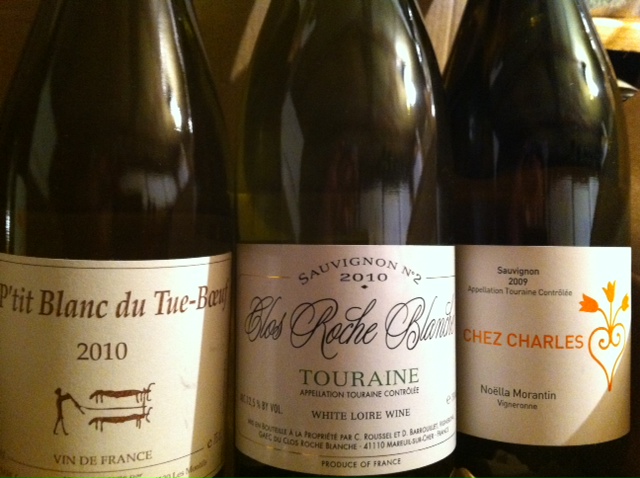
Sauvignons from Thierry Puzelat (Le Clos du Tue Boeuf), Clos Roche Blanche and Noëlla Morantin


“The wine is in true expression now than when it was first released”, spoke softly Didier of Clos Roche Blanche.  He was referring to the 2010 Sauvignon No. 2 as we tasted the various wines in the cellar during my January 2012 trip. Clos Roche Blanche Sauvignon No. 2 is so singular. When tasted out of a barrel, the Sauvignon No. 2 is so energetic that I fear the wine is going to shatter the glass that I am holding.  The wine is like sucking mineral through a straw with a fruit that reminds of grapefruit. After about a year in bottle, the wine transforms not dissimilar to Chenin Blanc but not quite.  The fruit recalls quince.  The minerality remains. 

When I visited Noëlla Morantin, a marquee Sauvignon vigneronne, she had two different Sauvignons in the barrels/demi-muids.  Hers are released later when the youth of Sauvignons settles down to quince and minerality reflections.  Her Sauvignon ages gracefully.  Thierry Puzelat also makes Sauvignon wines and his is often blended with a portion of Menu Pineau and Fie Gris.  His Sauvignon based wines are full of energy and nervous tension. “Le P’Tit Blanc tastes better the next day after the bottle has been opened”, a local merchant told me recently.  And that sums up the freshness and energy in the Thierry Puzelat’s Sauvignon.

The majority of Sauvignon Blanc on the market today does not go through malolactic fermentation.  Since the majority of vineyards are industrially farmed and mechanically harvested (about 95% according to Art of Eating, September 2010 issue).  This mechanical harvest results in grapes to bleed before they arrive at the winery.  So, to prevent the bacterial spoilage, the juice is dosed with sulphur.  It kills the bacteria, which is required for the malolactic fermentation.  Thus by a default, the malolactic is prevented.  There are, of course, vignerons who cultivate organically and harvest by hand but intentionally block malolactic fermentation to achieve a certain style. 

Clos Roche Blanche, Noëlla Morantin and Thierry Puzelat all let their Sauvignon go through malolactic fermentation. “By nature, the Sauvignon wants to go through malo”, was a recurring theme when I visited them.  Clos Roche Blanche, Noëlla Morantin and Thierry Puzelat are making singular Sauvignons – all expressions of beauty in truth.  Doubt the conventional.  Drink the exceptional.

Monday, February 27, 2012

Les Caves Auge in Paris

In Paris, an unassuming wine shop in the 8th Arr. has influence on wine lovers like no other.  The wine shop, like the majority of the vignerons that Auge represents, is simple and humbling that if you are not familiar with Auge, you may skip it without giving it too much thought. The website says in a small font ‘depuis’ (since) 1850 and not much else.

It is a wine shop that is absolutely clear on what it represents.  In terms of philosophy, Auge reminds me of another great wine shop - Chambers Street Wines.  Both wine shops are hugely successful.  


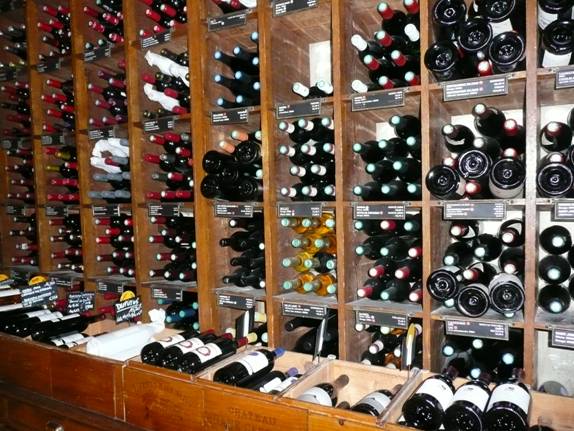
There is greatness and joy about a wine shop that is steered by the focused ideal of owners and not by the broad sense of general consumer.  Least to me, Auge has no interest in pleasing everyone.  If you love wines made by vignerons who give a shit, you will likely love Auge.  Auge is so jam packed with wines that, if it were in BC, a city would close it down by quoting some silly bylaw.  The photo is the inside Auge taken during my last trip.

I can spend hours in Auge.  If you are in Paris, it is a great place to spend some time.  And, say, you are looking for a special wine like Pierre Overnoy from Jura, ask sales staff. He or she may disappear down to a cellar and fetch a bottle for you - provided that you pass the unofficial sales staff's verbal wine test.  Or simply grab a bottle or two that you never heard of, buy a baguette sandwich, and dance down to the banks of Seine with a corkscrew and glasses.  And oh, you can have wine with a baguette sandwich in public places in Paris and not worry about a social disobedience ticket.  If weather is unfriendly, I usually go back to my hotel room – which is just as nice.  

Friday, February 17, 2012

Catherine & Pierre Breton Avis de Vin Fort & Trinch! - Two Wines Separated After Birth

“Brian, if you keep analyzing, I should not sell this wine to you,” Pierre announced quietly.  That was Pierre Breton as I kept re-tasting the Avis de Vin Fort with him at his domain during my initial buying trip. 

Like falling in love, my heart was committed before my mind was.  The wine was nothing like I have ever tasted.  It defied every category.  It was not red; it was not rosé.  Avis de Vin Fort does not want to be categorized or labelled.  "Once you label me; you negate me," as the Danish philosopher Soren Kierkegaard once penned.

Avis de vin Fort has only one purpose: PLEASURE!.  And I think that was Pierre’s point when he made the wise comment to me.  The more one analyzes, the more one gets disconnected from the pleasure of wines.

Avis de Vin Fort macerates for 5 days only.  Typically, most red is macerated for 3 to 4 weeks.  The wine has zero extraction and 100% personality.  Avis de Vin Fort is made from 100% cabernet franc.  So, the wine has a bit of bite.  Despite the fact that the wine is macerated for five days only, it spends about 4-5 months in neutral demi-muids (500 litre barrels). “Cabernet Franc needs some elévage”, Pierre told me. Below is a picture of Avis de Vin Fort (AVF) 2011 in a demi-muid when I visited Pierre and Catherine in January 2012.  The wine weighs in no more than 12% alcohol just about every year.  My family drinks Avis de Vin Fort well chilled and with anything from steak to roast chicken.   

Trinch! is Avis de Vin Fort’s sibling.  Both cuvees are from the same vineyard.  In fact, they both start the life in the same vat.  Except, the Avis de Vin Fort is bled off the vat after 5 days whereas Trinch! carries on with skin contact for additional couple of weeks or so.  Both wines accompany various bistro dishes well.

By the way, Avis de Vin Fort (meaning ‘strong wind warning’) is a play on words.  It is an ancient saying for sailors to take a cover and go to the safety of shore when there is a strong wind warning and drink strong wines.  The wine, of course, is light and refreshing.  Trinch! is a sound that is produced when glasses are clunk together as a gesture of celebration.   

Avis de Vin Fort and Trinch! - two siblings with equally distinctive personality. When I have a dinner party, I sometimes serve the Avis de Vin Fort and Trinch! together.  It always surprises me which bottle empties first. 

Saturday, January 7, 2012

Louie, the Wild Mushroom Purveyor

“Yes, I like dried morels better, too”, mentions softly Louie.  Louie is one of my food heroes.  Often, and not always, Louie can be found at Granville Island on Thursdays.  Sometimes, his son stands-in for him because Louie is out in the forest foraging mushrooms.

Louie is my mushroom mentor during chanterelle & mushroom season in autumn, morel season during spring, and dried-mushroom season anytime.  During autumn, when the wild mushrooms are at most abundant, I simply buy whatever Louie suggests.  I sauté the mushrooms with some olive oil or butter with some shallots and devour them with toasted baguette or brioche.  Here is a recipe using Louie’s wonderful morels:

Fried Eggs with Morel Cream Sauce (serves 2)

  • 10-12 dried morels (soak for about 10 minutes in least amount of boiling water as possible - about 1/4 cup of water).
  • 4 free range eggs
  • 3 Table spoon of butter
  • 1 Table spoon of minced shallots
  • 3-4 Table spoons of apple cider, red, or white vinegar
  • ¼ cup of whipping cream
  • Salt and pepper to taste
  • Some chopped parsley
This is not breakfast.  First, pour your loved one and yourself a glass of wine.  Warm up the plates in the oven (around 150 F).  Place a frying pan on medium heat.  Add the butter. When the butter foams, crack eggs and fry them sunny-side up.  Remove the cooked eggs to the warmed plates.  Add the mined shallots and  sauté them for a minute or two.  Add the vinegar to the pan and cook until there is a very little vinegar left.  Add the juice from the soaked morels to the pan and careful to discard a tablespoon or so of the juice at the bottom of the bowl as it will contain some soil and/or impurities.  Increase the heat and cook for 1-2 minutes more until the liquid is reduced about half.  Reduce heat and add the cream and soaked morels.  Cook a couple of minutes.  Add salt & pepper to taste.  Spoon over the sauce around the plates with eggs and serve with some crusty baguette.  Eh Voila.

Soak the dried morels or other mushrooms and try them in a risotto dish.  All mushroom dishes are wine friendly.  I often have the wine with Pinot Noir or Gamay based wines, such as Le Tel Quel, Cheverny or Pinot Noir from Thierry Puzelat(Puzelat-Bonhomme or his family estate of Le Clos du Tue-Boeuf) or LaBoudinerie or Mon Cher from Noëlla Morantin.  Life is good with Louie’s mushrooms.  Thank you Louie!

Saturday, December 10, 2011

A Day in Life of Vigneron and Bistro Owner

On a blistering cold evening last year in Café de la Nouvelle Mairie, a Paris bistro, when I was having dinner, a vigneron walked-in.  It must have been past 9 PM.  With him, he carried six bottles of wine.  His eyes were exhausted.  His hunger was apparent.  It looked as though it was the last stop before he headed back home.  The bistro owner greeted him, spoke briefly, and guided him to a table.

As far as I could tell, listening from distance and observing gestures, the vigneron was unknown to the bistro owner.  He gently grabbed and leaned over to the passing-by waitor and spoke to him.  Within minutes, there were a bowl of warming soup, a plate of terrine and some bread on the table.  A plate of duck confit followed.  The bistro owner said something to the vigneron and left temporarily.  The vigneron indeed must have been hungry because the plates of foods were emptied quickly.

About ½ hour later, the bistro owner returned with a plate of cheese and a couple of wine glasses.  The bistro owner and vigneron were now tasting the wines that the vigneron had brought with him.  I can clearly tell the bistro owner was very impressed with the wines.  It was no longer a tasting as the bistro owner was now thoroughly enjoying the wines.

The bistro owner left the table and brought more plates of food.  Now, the vigneron and bistro owner were enjoying the wines with the food.  The bistro owner gestured to the sommelier, who was busy behind the zinc bar, to join.  The conversation ensued and I could sense a friendship bonding.  Their unexpected get together ended with a cup of espresso and sincerest handshake.  The vigneron reached his wallet to pay for the meal.  The bistro owner would have none of it and said in words that I can barely make out from the distance: “I look forward to your wine delivery next week.”

After I finished my meal with a cup of espresso, I stepped outside of the bistro to return to my hotel.  The outside felt much warmer than I had remembered.

Happy Holidays. 

Thursday, November 17, 2011

My Kinda Wine List – Less is More

It is hard to describe in words about the artisanal wine and food scene in Paris. The smell, the joie-de-vivre atmosphere, the crowded but inviting zinc bar, and the sense of abundance all add to euphoric experience.  The energy is happy and lively.  When I am at those familiar bistros (such as Le Comptoir, Le Baratin, Les Pipos and among others), who favour artisanal sources of ingredients and wines, I simply surrender to the sommelier.  I always seem to get a bottle or glass of wine that are intriguing and tasty.  I figure the sommeliers spend more time with their wine list than I.  Besides, you don’t have to be a wine export to know if the wine list is conceived from love or fear. You will intuitively know.

My preferred wine lists from my favourite Parisian bistros tend to be thoughtfully small.  The lists are usually on chalk boards.  Often such wine lists have 1 or 2 sparkling, 5-7 reds, and about the same number of whites, and 1 or 2 sweet wines.  That is it! When a wine is sold out, it is simply wiped off the list. Of course, another wine is added immediately.  Eh voila!  No need to fuss over reprinting the wine list.  The wines continually rotate.  So, if you go the same bistro a week later, there will likely be different wines on the list but often from the same artisan.  I like that because it keeps the list lively and changing yet familiar. 

I like the small wine list in such bistros because it tells me the owner or sommelier went the extra mile to weed out the ones she/he does not want and present only the ones she/he wants.  Less is more as it were.  I would rather choose a wine from an exceptional list of a dozen than struggle to find one among dozens of standards.

Below is a super clip from Anthony Bourdain, who on his 100th episode of No Reservation went back to Paris, where he explores and enjoys the foods and wines in just such bistros.  Oh heck, I even noticed there is a bottle of G. Descombes Brouilly Vieilles Vigne in a scene.  I urge you to try one of the bistros mentioned in the video the next time you are in Paris.  When you are in one of the bistros, you will understand what I meant by “you will intuitively know”.


Tuesday, November 8, 2011

My Backyard Apple Tree is Pineau D’Aunis!

Joan, my house’s former owner, planted the apple tree in my backyard.  As far as I can tell, the apple is heirloom variety.  The apple does not resemble any other apples that are widely available at grocers. Every year, independent of weather in summer, the apples appear to ripen only after the first frost of the season in Vancouver.  They are truly remarkable and tasty.  Firm in texture, they are juicy, sweet and citrus all at once.  Perfectly balanced!  I look forward to the apples every other year because the tree skips a year of production – somewhat like Pineau D’Aunis as I have been told by Didier Barrouillet of Clos Roche Blanche.  So, not knowing the heirloom varietal of my apple tree, I nicknamed it Pineau D’Aunis.

This year, the tree decided to produce.  BONUS!  In addition to simply eating the apples, they make beautiful apple sauce.  Here is my recipe:

-          6 apples (pealed, cored and sliced)
-          ¼ onion(peeled and sliced thinly)
-          2-3 table spoon of virgin olive oil
-          2-3 table spoon of butter
-          A pinch of cinnamon
-          2-3 table spoon of honey
-          ¼ cup of apple vinegar
-          Salt and pepper to taste

In a pan on a medium high heat, add olive oil and butter together. Add all ingredients, except apple vinegar.  Cook for 5-7 minutes.  Stir often.   Smash roughly with a spoon as apples cook.  Add the vinegar and cook additional 2-3 minutes. 

The apple sauce makes an amazing accompaniment to pork chops, terrines and sausages.  Try spreading the apple sauce over a baguette with slices of prosciutto to balance out the salty cured meat.  Store leftover in a jar and it will last 3-5 days in a fridge. 

Here is a Puy Lentil and Sausage dish.  A natural choice of wine for the dish is Auvergne from Jean Maupertuis.  Puy Lentil comes from Auvergne. And, of couse, Auvergne is a region well known for all types of sausages.  I buy the sausages from Freden (made with hormone free meats and chemical free ingredients) and they are available at Famous Foods.